Your sales team lives in one system, support in another, and marketing sends a spreadsheet every Monday. Once a company grows into that tangle, choosing the best enterprise CRM software stops being an IT purchase and becomes a decision about how every customer-facing team will work together.
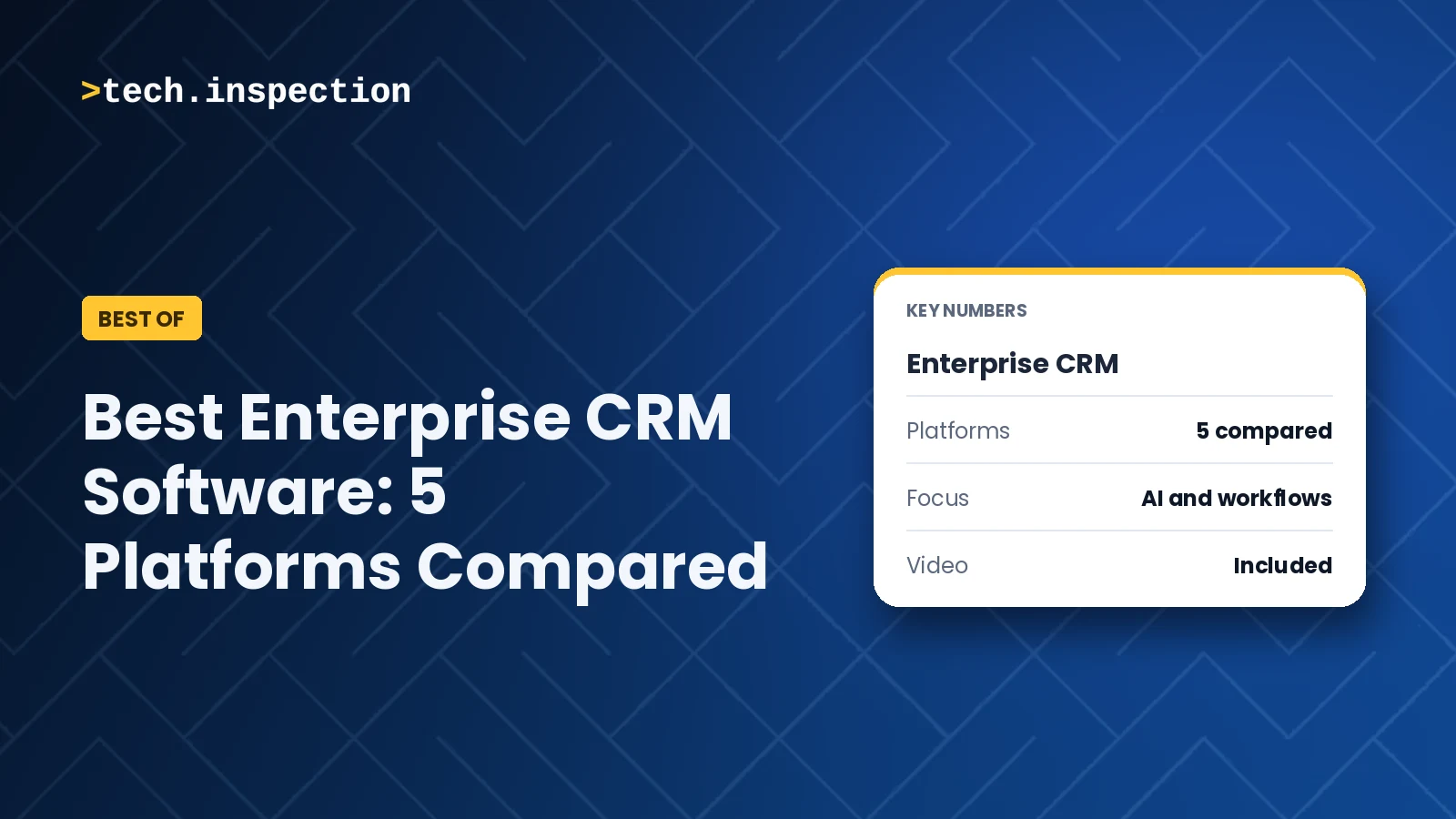
Short answer: The best enterprise CRM software depends on how much control you want: Creatio for no-code customization, HubSpot for connected marketing, sales and service, Salesforce for complex operations, Zoho CRM for broad built-in AI, and GoHighLevel for automated lead follow-up.
In the video: 0:38 Creatio · 2:19 HubSpot · 3:29 Salesforce · 4:37 Zoho CRM · 5:46 GoHighLevel
| Platform | Best for | Standout |
|---|---|---|
| Creatio | Teams that want to build and change their own workflows without heavy coding | Business Studio no-code design plus AI Studio for agents |
| HubSpot | Companies whose marketing, sales and service data sits in separate tools | Smart CRM shared by Marketing Hub, Sales Hub and Service Hub |
| Salesforce | Large organizations with complex sales cycles and high service volumes | Agentforce AI agents with Slack and Data 360 |
| Zoho CRM | Businesses that want broad CRM functions with built-in AI | Zia assistant and CRM for Everyone teamspaces |
| GoHighLevel | Businesses that want the CRM to handle lead capture and follow-up | Conversation AI, Voice AI and Ask AI |
How we chose
We chose these five platforms because our video compares them on where each one puts its emphasis: customization, AI, or simpler everyday workflows.
Each description follows our video script, and we checked product names and features against every vendor’s own website on November 1, 2026. This is a research-based roundup, not a hands-on benchmark, so we do not give test scores. The order follows our video, and affiliate availability never decides it. You can read how we work on our editorial standards page.
Enterprises are the core CRM buyers. Grand View Research values the global CRM market at $79.6 billion in 2025 and reports that large enterprises held 59.9% of CRM revenue in 2024.
Which enterprise CRM platforms are worth shortlisting?
Creatio, HubSpot, Salesforce, Zoho CRM and GoHighLevel are the five enterprise CRM platforms worth shortlisting, and each one is aimed at a different buying problem.
1. Creatio
Best for: larger businesses that want to customize and automate their CRM without relying on developers · Standout: no-code Business Studio with AI agents built into CRM processes
Creatio is an AI-native CRM for companies that want control over how customer workflows run. It combines ready-to-use Sales, Marketing and Service CRM with no-code customization, so a team can adapt the system as the business changes.
With Business Studio, teams use visual designers and AI coding agents to build applications, shape data models and design workflows. AI Studio manages the lifecycle of AI agents, and AI Twin lets employees build personal agents for everyday work. Creatio’s site lists unlimited users, custom agents, applications, workflows, custom objects and API calls. Because the platform is built around designing your own processes, it rewards a team that has someone ready to own that configuration.
- Visual designers and AI coding agents in Business Studio
- AI Studio for managing agents and AI Twin for personal agents
- AI agents for lead qualification, meeting preparation and customer interactions
- Unified customer data, custom objects and API capabilities
- Bank.AI, a banking CRM and workflow platform for banks and credit unions
2. HubSpot
Best for: growing enterprises whose customer information is scattered across departments · Standout: one connected platform for marketing, sales and service
HubSpot brings marketing, sales and customer service onto one connected customer platform. Its Smart CRM gives teams a shared view of contacts, companies, deals and customer activity, so marketing can pass better leads to sales and service can see the same history after a deal closes.
Marketing Hub covers lead generation, SEO, campaigns and reporting. Sales Hub covers pipelines, prospecting, sequences, forecasting and lead scoring, and Service Hub adds a help desk, knowledge bases, feedback tools and ticket routing. HubSpot also lists an Agent Hub for building and managing AI agents, and says its AI agents can resolve over 65% of customer inquiries, a vendor claim we have not tested. The connected design pays off most when several teams use several hubs, so a company that needs only one function will use less of it. If email automation is your main interest, our ActiveCampaign review shows how a marketing-first tool approaches it.
- Smart CRM as the shared customer record
- Marketing Hub, Sales Hub and Service Hub
- Agent Hub with Customer, Prospecting and Data agents
- More than 2,000 integrations, according to HubSpot
3. Salesforce
Best for: large organizations with complicated sales cycles, high service volumes or several customer-facing teams · Standout: Agentforce AI agents on one connected platform
Salesforce is built for businesses that need a CRM ecosystem able to handle complex operations across departments. It brings sales, service, marketing, commerce and customer data together, so teams share one customer view instead of working in isolated systems.
Sales Cloud covers pipeline and deal management, forecasting, quoting, meetings and lead scoring. Service Cloud covers case management, knowledge, contact-center tools and omnichannel support. The 2026 shift is Agentforce, which adds AI agents that can assist employees or handle certain customer tasks on their own, using business data, following defined guardrails and handing work back to humans when needed. Salesforce also connects with Slack and Data 360. The breadth is the point, so a smaller or single-department team should scope what it will actually use before committing.
- Sales Cloud and Service Cloud, plus Marketing Cloud and Commerce Cloud
- Agentforce AI agents with guardrails and human handoff
- Slack and Data 360 connections
- MuleSoft and AgentExchange for integrations
4. Zoho CRM
Best for: businesses with repetitive processes or teams working in separate systems · Standout: built-in AI through Zia and dedicated teamspaces for non-sales teams
Zoho CRM combines broad functionality with built-in AI. It covers the core sales journey with lead and contact management, deal pipelines, forecasting, workflow automation and Blueprint process controls, plus follow-ups by email, phone, WhatsApp, social media, live chat and SMS.
Zia, Zoho’s AI assistant, can score leads, predict outcomes, summarize emails, detect anomalies and suggest next steps. Zoho’s site also lists a Zia Agent Store with pre-built agents and a Zia Agent Studio for custom ones. CRM for Everyone lets marketing, finance, legal and operations teams work in dedicated teamspaces without sales features they do not need. Zoho says the platform integrates with more than 1,200 business apps. Teams that want a very light setup should check how much configuration the process controls need before rollout.
- Lead and contact management, pipelines and forecasting
- Blueprint process controls and workflow automation
- Zia assistant, Zia Agent Store and Zia Agent Studio
- CRM for Everyone teamspaces
- Dashboards and analytics for leaders
5. GoHighLevel
Best for: businesses that want the CRM to actively handle lead capture, follow-ups and repetitive marketing work · Standout: a growing AI layer across chat, voice and in-platform prompts
GoHighLevel, also called HighLevel, is built around bringing CRM, marketing, communication and automation into one place. It gives businesses pipelines and opportunities for tracking deals, while workflows automate follow-ups and move contacts through stages.
Its AI layer is where it stands out. Conversation AI answers questions, qualifies leads, collects information and helps book appointments across SMS, Facebook, Instagram and live chat. Voice AI extends that to phone conversations, and Ask AI works as an in-platform copilot that retrieves data, creates content, manages CRM records and acts on plain-language prompts. Managed agents handle more autonomous CRM tasks, and AI tools cover websites, funnels, email, content and reviews. GoHighLevel’s own site leads with agencies and business owners rather than large IT organizations, so enterprise buyers should confirm their governance and security needs in a demo. It offers a 14-day free trial. For a side-by-side of two email-focused tools, see our ActiveCampaign vs Mailchimp comparison.
- Pipelines, opportunities and workflow automation
- Conversation AI across SMS, Facebook, Instagram and live chat
- Voice AI for phone conversations
- Ask AI copilot and managed agents
- AI tools for websites, funnels, email, content and reviews
What is the best enterprise CRM software for your team?
The best enterprise CRM software matches your biggest constraint, and each of these five platforms answers a different one.
| If your priority is | Choose | Why |
|---|---|---|
| Building your own workflows without heavy coding | Creatio | No-code Business Studio and AI Studio |
| One shared record across marketing, sales and service | HubSpot | Smart CRM connects Marketing Hub, Sales Hub and Service Hub |
| Complex operations at large scale | Salesforce | Sales Cloud, Service Cloud and Agentforce on one platform |
| Broad CRM functions with built-in AI | Zoho CRM | Zia, Blueprint controls and CRM for Everyone |
| Automated lead capture and follow-up | GoHighLevel | Conversation AI, Voice AI and workflows |
Before you commit to any of them, run a short trial. In your first week, import a sample of real contacts, connect one inbox and build one automation. If any of the three fails, move on. Then read the vendor’s trust or security page for single sign-on, audit logs and data location, because those details often differ by plan. If your need is project tracking rather than customer data, our Smartsheet guide covers that side.
FAQ
What is enterprise CRM software?
Enterprise CRM software is a customer relationship management platform built for large organizations with many teams and complex sales or service processes. It centralizes customer data, automates workflows and adds governance, scale and integrations that smaller CRMs may not offer.
Which enterprise CRM is best for no-code customization?
Creatio is the strongest fit in this list for no-code customization. Its Business Studio lets teams use visual designers and AI coding agents to build applications, data models and workflows without traditional coding.
Is HubSpot an enterprise CRM?
HubSpot positions itself for enterprises as well as small businesses, and its site has a dedicated Enterprise Customer Platform page. It combines Smart CRM with Marketing Hub, Sales Hub and Service Hub, which suits companies that want one connected system across departments.
What does Agentforce do in Salesforce?
Agentforce is Salesforce’s layer of AI agents. These agents can assist employees or handle certain customer tasks on their own, use business data, follow defined guardrails, take actions and hand work back to humans when needed.
Does GoHighLevel offer a free trial?
Yes. GoHighLevel’s website advertises a 14-day free trial. Check what the trial includes on its page before you start, because plan features can change.
How do I choose between these five CRMs?
Start with your biggest constraint: customization, shared data across teams, scale, built-in AI or automated follow-up. Shortlist the platform that matches it, then run a one-week trial with real contacts, one connected inbox and one automation before you decide.
Tech Inspection tests software hands-on and records every review on video. Building a SaaS? Get your product reviewed.

AKM Aminul Islam leads the SaaS department at Backspace International, where he turns software know-how into trusted reviews and a growing business. He owns go-to-market, the department’s workflow and revenue, scouts new opportunities, and takes international client meetings through to a signed deal. With 12+ years across technical writing, product documentation, video, and SaaS growth, he brings a practitioner’s eye to every tool Tech Inspection tests.